Classical Greek Oligarchy by Simonton Matthew
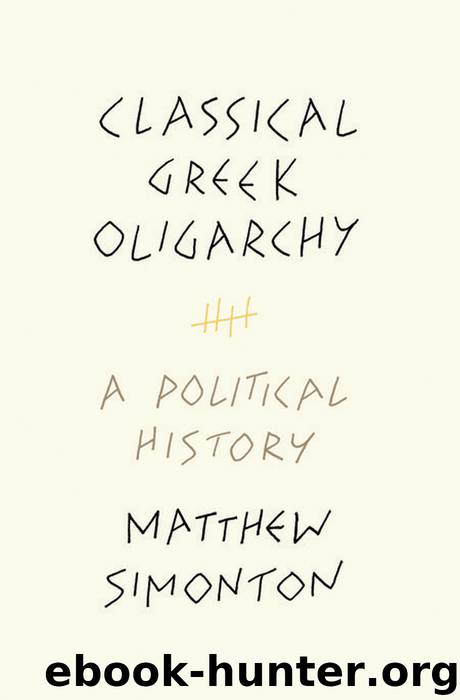
Author:Simonton, Matthew
Language: eng
Format: epub
Publisher: Princeton University Press
Published: 2017-05-26T16:00:00+00:00
1. [Arist.] Rhet. ad Alex. 1424b8–10: μηδὲ συνάγειν ἐκ τῆς χώρας τὸν ὄχλον εἰς τὴν πόλιν· ἐκ γὰρ τῶν τοιούτων συνόδων συστρέφεται τὰ πλήθη καὶ καταλύει τὰς ὀλιγαρχίας.
2. Scott 2010, 2013; Riess and Fagan 2016; Ober 2008 (esp. 190–205); Dickenson and van Nijf 2013. Hellenistic and Imperial scholarship in particular has engaged productively with the idea of political space: see further Ma 2013; van Nijf 2011; Viviers 2010.
3. See especially Fearn 2009 on “oligarchic Hestia” (by definition hearth-based and thus interior).
4. Hom. Il. 6.124; Alcaeus fr. 130b.3–5 Liberman; Xenophanes fr. 3 West.
5. See Raaflaub and Wallace 2007: 24, 28–29; Morris 1996: 27–28, 40–41; Duplouy 2006.
6. Arrivistes: Lane Fox 2000: 42–45. Demagogues: Robinson 1997: 115–16. Rivals: van Wees 2000: 60–67.
7. Cyclopes (Od. 9.215): Nagy 1985: 44, § 29 n4. Colonists: Nagy 1990: 71n96, 267n93.
8. One of the rich men in the villages, Telestagoras, is honored by the demos, which suggests that the demos had a greater presence in the periphery than in the city-center.
9. Fr. 50 Wehrli, with Suda s.v. Γέργηθες and Gorman 2001: 106–7; van Wees 2008: 29. For the tribe of the Gergithes in the Troad, see Hdt. 5.122.2. Heraclides (as quoted by Athenaeus) does not actually specify that the Gergithes lived in the countryside, but their method of killing the children of the rich—by having them trampled on threshing-floors—indicates their rural origins. For alternative versions of the story, see Plut. QG 32=Mor. 298c–d; Hdt. 5.28–29.
10. Plut. QG 1 = Mor. 291e. For a discussion of the 180 as an oligarchy, see Whibley 1896: 159. I am hesitant to apply the label to the institution if it is genuinely Archaic.
11. e.g., Pol. 4.1292b25–29, 5.1305a18–20, 6.1318b9–21, 1319a6–19, 28–32; Philoch. FGrH 328 F 2. Cf. Herodotus’s description of early Media, in which the people “dwell in villages” (Hdt. 1.96.2).
12. Some scholars have thought that the name “Gergithes” in Miletus indicates an indigenous population that had been reduced to serf-like status by Greek settlers (e.g., Halliday 1928: 146; Berve 1967: 579 [“wohl nichtgriechischer Abstammung”]); but Gorman gives convincing arguments otherwise (2001: 106–107). As for the Epidaurian “dusty-feet,” it was common in the Greek world to identify (and denigrate) a country bumpkin by the state of his feet: Ar. Eq. 315–21; Theophr. Char. 4.2, 13 (on the agroikos); Cratinus fr. 77 K-A.
13. Nic. Dam. FGrH 90 F 58.1 (cf. Ephorus FGrH 70 F 179 apud Diog. Laert. 1.98; Arist. fr. 611.20 Rose).
14. Hippias of Erythrae FGrH 421 F 1. For more on this source, see below, section 4.3.
15. See Forsdyke 2005: ch. 2 and passim. I question some of Forsdyke’s arguments about the dangers of exile in chapter 2, section 2.5.
16. A potential exception is to be found in the story of the tyrant Syloson of Samos’s ruling over a depopulated island. This state of affairs gave rise to a proverb: “Because of Syloson there is a lot of room” (Arist. fr. 574 Rose; Strabo 14.1.17). The emptying out of the polis was not Syloson’s intention, however, but resulted from a “netting” carried out by the Persians, who then installed Syloson as tyrant (Hdt.
Download
This site does not store any files on its server. We only index and link to content provided by other sites. Please contact the content providers to delete copyright contents if any and email us, we'll remove relevant links or contents immediately.
The Secret History by Donna Tartt(18968)
The Social Justice Warrior Handbook by Lisa De Pasquale(12172)
Thirteen Reasons Why by Jay Asher(8856)
This Is How You Lose Her by Junot Diaz(6844)
Weapons of Math Destruction by Cathy O'Neil(6223)
Zero to One by Peter Thiel(5743)
Beartown by Fredrik Backman(5690)
The Myth of the Strong Leader by Archie Brown(5473)
The Fire Next Time by James Baldwin(5393)
How Democracies Die by Steven Levitsky & Daniel Ziblatt(5182)
Promise Me, Dad by Joe Biden(5120)
Stone's Rules by Roger Stone(5060)
A Higher Loyalty: Truth, Lies, and Leadership by James Comey(4919)
100 Deadly Skills by Clint Emerson(4888)
Rise and Kill First by Ronen Bergman(4744)
Secrecy World by Jake Bernstein(4710)
The David Icke Guide to the Global Conspiracy (and how to end it) by David Icke(4664)
The Farm by Tom Rob Smith(4475)
The Doomsday Machine by Daniel Ellsberg(4463)
